.png)
.svg)
.png)

What Happens During a Root Canal Procedure?
.png)
.png)
During a root canal procedure, a dentist removes the infected or inflamed pulp from inside a tooth, cleans and shapes the hollow canals, fills them with a rubber-like material called gutta-percha, and seals the tooth to prevent future infection. The procedure typically takes 60 to 90 minutes and is performed under local anesthesia, so most patients feel pressure but no pain at all. Root canals are one of the most common dental procedures in the United States, with more than 15 million performed every year according to data from the American Association of Endodontists (AAE). This article explains exactly what happens during a root canal, step by step, answers the most searched questions about pain, recovery, and timing, and helps you know when the procedure simply cannot wait.
What Happens During a Root Canal Procedure, Step by Step?
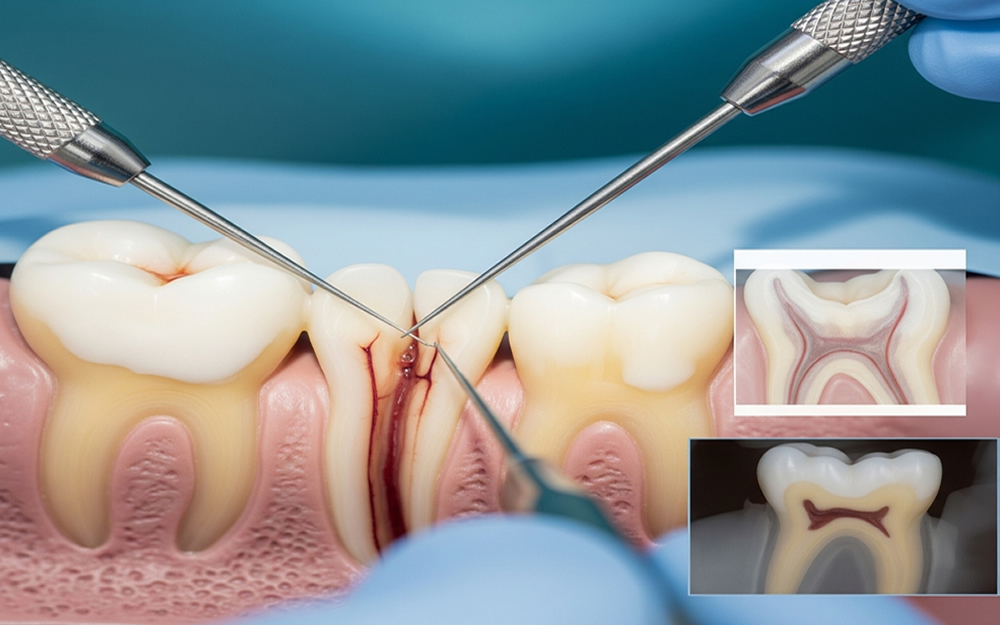
During a root canal procedure, the dentist follows a clear series of steps to remove the infection, clean the tooth, and seal it permanently. Here is what happens from start to finish:
Step 1: Diagnosis and X-rays. Before any treatment begins, the dentist takes X-rays to see the shape of the root canals and check how far the infection has spread. This gives the dentist a precise map of what is happening inside the tooth and helps plan the treatment.
Step 2: Anesthesia. A local anesthetic is injected into the gum near the affected tooth. This fully numbs the tooth and the surrounding area. Most patients feel a brief sting from the injection and then nothing at all during the rest of the procedure. For patients who feel nervous, the team at Castellanos Dental in West Hialeah is experienced in helping anxious patients feel calm and in control.
Step 3: Dental dam placement. A small rubber sheet called a dental dam is placed over the tooth. It isolates the tooth from the rest of the mouth, keeping it clean and dry throughout the procedure and preventing bacteria from the saliva from entering the canal.
Step 4: Access opening. The dentist drills a small hole through the top of the tooth to reach the pulp chamber inside. This opening provides access to the infected tissue and the root canals below it.
Step 5: Pulp removal and canal shaping. Using very small files, the dentist removes the infected or inflamed pulp tissue from the pulp chamber and each root canal. The canals are then shaped and widened to make them easier to clean and fill. The canals are rinsed with an antiseptic solution to flush out bacteria and debris.
Step 6: Filling the canals. Once the canals are clean and dry, they are filled with gutta-percha, a rubber-like biocompatible material that seals the space completely. An adhesive cement is used to keep the gutta-percha in place and prevent bacteria from re-entering.
Step 7: Temporary or permanent seal. A temporary filling is placed to close the access hole until a permanent crown can be made. In some cases, the permanent filling or crown can be placed in the same visit.
Step 8: Crown placement. A follow-up appointment is scheduled to place a dental crown over the treated tooth. This step is critical. Research indicates that teeth with proper crown restoration after a root canal have nearly twice the survival rate compared to those left without adequate restoration. Without a crown, the treated tooth is brittle and at high risk of fracturing.
The root canal therapy team at Castellanos Dental walks every patient through each of these steps before treatment begins, so nothing comes as a surprise.
How Long Will a Root Canal Procedure Take?
A root canal procedure will take between 60 and 90 minutes for most teeth. Simple front teeth with a single root can be completed in as little as 30 to 45 minutes. Molars with two or three roots and more complex canal systems can take closer to 90 minutes or may require a second appointment to complete.
Most patients have no trouble returning to normal activities the same day or the following day. The procedure itself is done under anesthesia, so there is no pain to manage during the visit. Any soreness that follows comes from the surrounding gum tissue healing, not from the tooth itself, since the nerve inside the tooth has been removed.
What Is the Hardest Tooth to Get a Root Canal On?
The hardest tooth to get a root canal on is the upper first molar, also called the maxillary first molar. This tooth typically has three roots and can sometimes have four separate canals, making it the most anatomically complex tooth for root canal therapy. The extra canals are harder to locate and clean completely, which is why molar root canals take longer and are more technically demanding than front tooth procedures.
Second molars and lower molars can also be challenging because of their curved roots and the difficulty in accessing them at the back of the mouth. Research published in clinical endodontic literature confirms that tooth type and root anatomy are significant factors in both procedural difficulty and long-term outcome. Front teeth, called incisors and canines, are the easiest because they typically have a single straight root with one canal.
If you have been told you need a root canal on a back molar in the Hialeah or Miami Lakes area, it is worth asking your dentist whether the case is better handled by a general dentist or a specialist endodontist. According to East Carolina University's School of Dental Medicine, endodontists perform an average of 25 root canals per week, while general dentists perform fewer than two. That volume of experience matters when the canal system is complex.
Is a Root Canal Painful? What Is the Most Painful Stage?
No, a root canal performed under modern anesthesia is not painful during the procedure. The most painful stage of a root canal is actually before treatment, when the infection is at its worst. The pressure, throbbing, and heat sensitivity caused by an inflamed or abscessed tooth are far more intense than anything experienced during the procedure itself. The root canal is designed to stop that pain, not cause it.
According to the Cleveland Clinic, thanks to modern anesthesia techniques, root canals are usually no more painful than getting a filling. You may feel pressure as the dentist works inside the tooth, but you should not feel sharp pain. If you do feel pain during the procedure, tell your dentist immediately. They can add more anesthetic.
After the procedure, once the anesthesia wears off, mild soreness and tenderness around the treated tooth is normal for the first 24 to 48 hours. This discomfort peaks within the first one to two days and then gradually improves day by day. According to clinical guidelines from the American Association of Endodontists, pain should trend downward each day. Most patients manage this stage comfortably with over-the-counter ibuprofen or acetaminophen.
What Day Is Root Canal Pain the Worst?
Root canal pain is worst on the first or second day after the procedure. This is when the inflammation from the treatment is at its peak. The surrounding ligament and bone tissue are still adjusting to the procedure, and any pre-existing infection that was present may still be resolving. By days three to five, most patients feel significantly better. If pain worsens after day three or five instead of improving, that is a sign something may need attention and you should contact your dentist promptly.
How Many Days Rest Is Needed After a Root Canal?
Most patients need just one day of rest after a root canal, and many return to work or school the same day as the procedure. The anesthesia wears off within a few hours, and while some mild soreness follows, it is rarely severe enough to prevent normal daily activity. Rest is helpful for the first 24 hours, especially avoiding strenuous physical activity that could increase blood flow and worsen swelling.
Eating soft foods for the first few days helps too. Yogurt, mashed potatoes, soup, and smoothies are easy on the treated tooth and do not put pressure on the temporary filling. Chewing on the opposite side is also recommended until the permanent crown is placed.
Should You Take a Day Off Work After a Root Canal?
Whether you should take a day off work after a root canal depends on the complexity of the case and your personal pain tolerance. Most patients do not need to take a full day off. However, if the procedure was lengthy, if you had a severe infection beforehand, or if you feel groggy from any sedation medication, taking the rest of the day off is a reasonable choice. Very few patients need more than one day off from normal activity.
Do You Need Bed Rest After a Root Canal?
No, you do not need bed rest after a root canal. Rest means taking it easy for the first day, avoiding intense exercise, and letting the anesthetic fully wear off before eating. You do not need to stay in bed. Most patients drive themselves home after the procedure and resume light activities the same afternoon. If sedation was used, you will need someone to drive you and should rest more fully for the remainder of that day.
Can a Root Canal Last a Lifetime?
Yes, a root canal can last a lifetime. A large retrospective study published in Clinical Oral Investigations tracked 598 teeth treated with root canals for up to 37 years. The cumulative survival rates were 97% at 10 years, 81% at 20 years, 76% at 30 years, and 68% at 37 years. Endodontic success rates for the same teeth were 93% at 10 years and 81% at 37 years. These numbers show that with proper restoration and oral care, a root canal-treated tooth can function well for decades.
The single most important factor in how long a root canal lasts is whether a crown is placed promptly after treatment. Research from the National Dental Practice-Based Research Network analyzed over 71,000 root canal-treated teeth and found a median survival time of 11.1 years overall, with 26% of those teeth surviving beyond 20 years. Teeth restored with crowns consistently outperformed those without.
Patients in the Hialeah and Hialeah Gardens area who complete their root canal treatment with a properly fitted crown from Castellanos Dental give their tooth the best possible chance of lasting for many years, possibly for life.
How Long Will a Tooth Survive After a Root Canal?
A tooth will survive well after a root canal when it is properly restored with a crown and maintained with good oral hygiene. Multiple systematic reviews published in the International Endodontic Journal report that the pooled long-term tooth survival rate after root canal therapy ranges between 87% and 93% at 8 to 10 years. A large cohort study analyzing over 160,000 root canal treatments found a 10-year survival rate of approximately 83.8%.
Teeth treated after root canals that are restored promptly have nearly twice the survival rate of those left without adequate restoration. This is the clearest evidence in all of endodontic research: getting the crown placed is not optional, it is essential. A treated tooth without a crown is vulnerable to cracking, and a crack in a root canal-treated tooth is often unrestorable, meaning the tooth must be extracted.
Do All Root Canals Need a Crown?
No, not all root canals need a crown, but most do. Front teeth and canine teeth have a single root and experience less biting force, so in some cases a filling alone is sufficient to seal and protect the tooth after a root canal. Back teeth, including premolars and molars, almost always require a crown because they bear the full force of chewing and their structure becomes brittle after the pulp is removed.
Research consistently shows that posterior teeth restored with crowns after root canal therapy survive significantly longer than those restored with fillings alone. If your dentist recommends a crown, it is for very good reason. The crown protects the tooth from cracking and seals the margins to prevent reinfection. Skipping the crown to save time or money often leads to losing the tooth entirely, which costs far more in the long run.
Dental crowns at Castellanos Dental are crafted to fit naturally and blend seamlessly with surrounding teeth. The team ensures patients understand exactly what is involved in the crown process before any decisions are made.
How Many Root Canals Does the Average Person Have?
The average person in the United States has had at least one root canal during their lifetime, and roughly one-third of American adults have had at least one, according to statistics compiled from national dental health data. Worldwide, about half the adult population has had at least one root canal. The American Association of Endodontists (AAE) reports that over 15 million root canals are performed in the U.S. every year, which works out to approximately 41,000 procedures every single day.
Root canals are most common among adults between the ages of 22 and 44, with 12% of people in this age group reporting having had at least one. A second peak occurs in adults over 40, as decades of fillings, decay, and wear increase the likelihood of a tooth eventually needing endodontic treatment. Peak demand also occurs among younger adults aged 20 to 29 in populations with limited access to preventive dental care.
At What Age Do Most People Get Root Canals?
Most people get root canals between the ages of 20 and 44, with two clear peaks. The first peak is in the 20 to 29 age group, often linked to delayed dental care or limited access to preventive dentistry. The second and larger peak occurs in adults over 40, when years of dental restorations, repeated fillings, and progressive decay increase the number of teeth that eventually require endodontic treatment. Endodontists also see a rise in root canal need among adults in their 60s and beyond, as enamel weakens naturally with age.
Why Do Dentists Insist on Root Canals?
Dentists insist on root canals because a root canal is often the only way to save a tooth that has a dead or infected pulp. Without treatment, a dental abscess can form, the infection can spread to the jawbone, neighboring teeth, or even the bloodstream in severe cases. Losing a natural tooth also sets off a chain reaction: the surrounding teeth shift, the jawbone beneath the gap begins to deteriorate, and replacing the tooth with an implant or bridge involves far more cost and complexity than treating it with a root canal now.
A root canal eliminates the infection and preserves the natural tooth root, which keeps the jawbone intact and maintains the proper spacing and alignment of surrounding teeth. Saving a natural tooth is almost always better than replacing it, from both a health and a long-term cost standpoint. Studies consistently show root canal success rates ranging from 86% to 93%, making it one of the most reliable treatments in all of dentistry.
Can I Wait 6 Months for a Root Canal?
No, you should not wait 6 months for a root canal. Waiting that long with an infected tooth is not safe. A dental infection does not go away on its own. Over time it spreads: first into the bone surrounding the tooth, then potentially into adjacent teeth and gum tissue, and in serious cases into the jaw or neck. An untreated abscess can become a medical emergency. Waiting also increases the chance that the tooth becomes unrestorable and must be extracted rather than saved.
If cost or scheduling is the barrier, contact your dental office right away. Many practices, including Castellanos Dental in West Hialeah, offer financing options that make it possible to begin treatment without paying everything upfront. Delaying a root canal almost always leads to greater expense and greater health risk, not less. Patients across Hialeah and the Palm Springs North area are encouraged to call as soon as pain or swelling develops.
Flexible payment plans are available at Castellanos Dental. Visit the insurance and financing page to learn about options that can make urgent dental care affordable.
What to Do the Day After a Root Canal
The day after a root canal, eat soft foods, avoid chewing on the treated side, take over-the-counter pain relief as needed, and resume gentle brushing and flossing around the area. Most patients feel well enough to return to work, school, or daily activities the day after treatment. The anesthesia has fully worn off by then, and while some tenderness remains, it should be mild and improving.
Avoid very hot or very cold foods and drinks for the first few days, as the tooth and surrounding tissue can still be sensitive. Do not smoke after a root canal. Smoking slows healing and increases the risk of reinfection. If you had a temporary filling placed, do not chew hard or sticky foods that could dislodge it before your crown appointment.
TimelineWhat to ExpectWhat to DoDay 1 (procedure day)Area still numb; mild soreness as anesthesia wears offRest, eat soft foods, avoid the treated sideDays 1–2Peak soreness and mild swelling; discomfort is normalOTC pain relief (ibuprofen or acetaminophen), cold pack on cheekDays 3–5Significant improvement; most patients feel much betterReturn to normal activity; continue soft food dietDays 7–14Full comfort restored for most patientsCrown preparation appointment; resume normal diet1 month+Internal tissue healing complete; tooth fully functionalKeep up with routine dental checkups
Sources: Magnolia Dentistry root canal recovery timeline; American Association of Endodontists post-treatment guidance; Cleveland Clinic root canal recovery overview.
Are All Nerves Removed During a Root Canal?
Yes, all nerve tissue inside the treated tooth is removed during a root canal. The pulp, which contains nerves, blood vessels, and connective tissue, is completely extracted from the pulp chamber and every root canal in the tooth. Once the pulp is gone, the tooth no longer has its own nerve supply and cannot signal pain the way a live tooth can.
This does not mean the tooth is dead. The tooth continues to receive nourishment from the surrounding periodontal ligament and gum tissue. It stays anchored in the jawbone and functions normally for chewing. You simply will not feel temperature sensitivity or nerve pain in that specific tooth anymore. The surrounding gum and bone tissue still have their own nerves and can feel pressure, which is why some tenderness after the procedure is normal.
A tooth without its nerve is more brittle than a live tooth, which is exactly why a crown is placed afterward. The crown restores structural strength and protects the tooth from cracking under biting forces. For patients at Castellanos Dental across Miami Lakes and West Hialeah, the crown is always discussed as the essential final step in completing the treatment.
Frequently Asked Questions About Root Canals in Hialeah, FL
How long does a root canal procedure take at a Hialeah dental office?
A root canal procedure at a Hialeah dental office typically takes between 60 and 90 minutes for most teeth. Front teeth are faster, often 30 to 45 minutes, while molars with multiple roots can take up to 90 minutes or require two visits. At Castellanos Dental in West Hialeah, patients are always informed about expected appointment length before treatment begins so they can plan their day accordingly.
Can a root canal last a lifetime for patients in South Florida?
Yes, a root canal can last a lifetime. A long-term study published in Clinical Oral Investigations tracked root canal-treated teeth for up to 37 years and found a 93% success rate at 10 years, with meaningful survival even beyond 30 years. The key is timely crown placement after the procedure and keeping up with routine dental checkups. South Florida's climate and diet habits, including higher sugar beverage consumption, make preventive care especially important for patients in Hialeah and Miami Lakes.
Do all root canals need a crown in West Hialeah?
Most root canals need a crown, especially on back teeth like molars and premolars. A root canal removes the pulp that kept the tooth moist and flexible, leaving it brittle. Without a crown to distribute biting forces, the tooth is highly likely to crack. Front teeth with minimal remaining damage may be restored with a filling alone in some cases, but back teeth almost always require a crown. At Castellanos Dental, the team reviews each case individually before making a recommendation.
Is it safe to wait for a root canal if I'm in Hialeah with a toothache?
No, it is not safe to wait with an infected tooth. A dental infection does not resolve on its own and can spread to the jawbone, nearby teeth, and in serious cases to other parts of the body. If you are experiencing severe tooth pain, swelling, or a visible abscess near a tooth in the Hialeah area, contact Castellanos Dental immediately at (305) 820-4080. Early treatment is always safer and more affordable than delayed care.
How many root canals does the average person in the U.S. have?
The average American adult has had at least one root canal, and roughly one-third of U.S. adults have had at least one in their lifetime. The American Association of Endodontists (AAE) reports that more than 15 million root canals are performed in the United States every year, an average of 41,000 procedures every day. They are far more common than most people realize.
What is the most painful stage of a root canal procedure?
The most painful stage of a root canal is the period before treatment, when the infection inside the tooth is active and untreated. The procedure itself is performed under local anesthesia and is not painful. After treatment, mild soreness peaks within the first one to two days and resolves within three to five days for most patients. The pain relief that follows a successful root canal is one of the most dramatic improvements patients experience in all of dentistry.
How can Castellanos Dental in West Hialeah help with root canal anxiety?
Castellanos Dental is uniquely equipped to help anxious patients. Dr. Madeleine Castellanos-Gonzalez holds a background in psychology alongside her dental degree from Goldman School of Dentistry, which she uses to ease patient fears and build trust throughout every visit. The bilingual team creates a calm, unhurried environment for patients across Hialeah, Hialeah Gardens, Miami Lakes, and Palm Springs North. No patient is rushed, and every step of the root canal process is explained before it begins.
Final Thoughts
A root canal is not the scary procedure it is often made out to be. It is a precise, well-established treatment that has a success rate of 86% to 93%, saves millions of natural teeth every year, and delivers relief from some of the most intense tooth pain imaginable. The procedure itself takes about 60 to 90 minutes, is performed under anesthesia, and is no more uncomfortable than getting a filling for most patients. Recovery takes just a few days, and when the treated tooth is crowned promptly, research shows it can remain functional for decades, sometimes for life.
If you are experiencing tooth pain, swelling, or sensitivity that will not go away, do not wait. The infection will not resolve on its own and every day it progresses makes treatment more complex. The team at Castellanos Dental Aesthetics in West Hialeah, Florida, is ready to help. Dr. Madeleine Castellanos-Gonzalez and her compassionate bilingual team serve patients throughout Hialeah, Miami Lakes, Hialeah Gardens, and Palm Springs North with personalized, patient-first care. Call (305) 820-4080 today or visit Castellanos Dental to schedule your consultation and get the relief you need.
.png)
.png)

.png)


.png)
.png)
.png)
.png)
.png)

.png)
.png)
.svg)


