.png)
.svg)
.png)

How Invisalign Can Impact Your Facial Structure
.png)
.png)
Yes, Invisalign can impact your facial structure. When clear aligners correct bite problems and reposition misaligned teeth, the changes that follow go beyond just a straighter smile. Your jawline, lip support, cheek symmetry, and overall facial balance can all shift in noticeable ways. In this article, we cover exactly how Invisalign affects your facial structure, what changes are realistic to expect, and what the research actually says about bone remodeling and soft tissue shifts during orthodontic treatment.
How Does Invisalign Affect Your Facial Structure?
Invisalign affects your facial structure by gradually moving teeth into better alignment, which changes how the jaw sits, how bite forces are distributed, and how the surrounding soft tissues, like the lips and cheeks, are supported. According to data from Fortune Business Insights, adults now make up over 74% of the Invisalign market in 2026, many of them seeking treatment specifically because of how misalignment affects the way their face looks and feels.
Your teeth are not just tools for chewing. They are structural anchors for the lower third of your face. When they are crooked, crowded, or when your bite is off, the jaw cannot settle into its natural resting position. This puts strain on facial muscles and can create visible asymmetry. When clear aligners fix these issues, the whole face begins to balance out.
The changes are real, but they are also subtle in most cases. We are not talking about a surgical transformation. We are talking about refinements that add up over the course of treatment, making your profile look more natural, more proportionate, and more symmetrical.
What Is Bone Remodeling and Why Does It Matter?
Bone remodeling is the process your body uses to reshape the bone around your teeth as they move. When Invisalign applies gentle, steady pressure to your teeth, your body responds by breaking down bone on one side of the tooth and building new bone on the other. This is not harmful. It is the same natural process that makes orthodontic treatment possible at any age.
Research published in the National Institutes of Health (PMC) confirmed that clear aligner treatment in adults produces measurable changes in alveolar bone height and thickness, especially when arch expansion is part of the treatment plan. The study tracked patients over an average of 21.4 months and found distinct bone adaptation across different facial types. This is why the changes you see after Invisalign are not just cosmetic. The bone itself is adapting to support your new alignment.
For younger patients whose facial bones are still developing, the impact can be more significant. Adults see more modest changes because the bones are fully formed, but bone remodeling still happens throughout treatment, giving the results a stable foundation.
Does Invisalign Affect Your Face Shape?
Yes, Invisalign does affect your face shape, but the degree depends heavily on the type and severity of your bite issue. According to research published by the National Institutes of Health, orthodontic treatment subtly influences lips, cheeks, and facial profile in adult female patients. The changes are not dramatic, but they are consistent and measurable.
The lower third of the face, which includes the jaw, chin, and lips, is the area most affected. When misalignment is corrected, the jaw can settle into a more balanced position, which changes how the chin looks in profile. Lip support improves when the teeth behind them are no longer tipped inward or crowded. Even cheek prominence can shift slightly as the arch widens and teeth settle into better positions.
A key piece of data from the National Health and Nutrition Examination Survey (NHANES III) found that only 35% of American adults have well-aligned lower front teeth. Many of those patients are also dealing with bite-related decay that a tooth-colored filling alone cannot fully address without also correcting the underlying alignment. That means the vast majority of people walking around have some degree of bite imbalance that could be influencing the way their face looks right now.
Does Your Face Go Back to Normal After Invisalign?
Your face does not go back to its pre-treatment appearance after Invisalign if you wear your retainer as directed. The facial changes that happen during treatment, including improvements in jaw balance, lip support, and cheek symmetry, are supported by the new alignment of your teeth. As long as your teeth stay in their corrected positions, those facial improvements stay with you.
However, if you stop wearing your retainer, teeth can begin to drift. This is a process called relapse. When teeth drift back toward their old positions, the structural support they provide to the lips, jaw, and cheeks can shift as well. Experts consistently note that the first year after treatment is when relapse risk is highest without consistent retainer wear.
How Does Invisalign Impact Your Jawline?
Invisalign impacts your jawline by correcting bite problems that cause the jaw to sit in an unnatural position. A more aligned bite means the upper and lower jaws meet properly, which allows the jaw to rest in a more symmetrical and balanced resting state. Over time, this creates a more defined and proportionate lower face.
The most visible jawline improvements happen when overbites, underbites, and crossbites are corrected. Each of these bite problems pulls the jaw in a direction it was not meant to go, and each one affects the jawline in a different way. Fixing them allows the jaw to find its natural home, and the face adjusts to reflect that.
We see this often with patients who have been living with a bite problem for years. Once their teeth are aligned with Invisalign treatment, they notice that their side profile looks different in a way they cannot always explain right away. The jaw just looks more balanced.
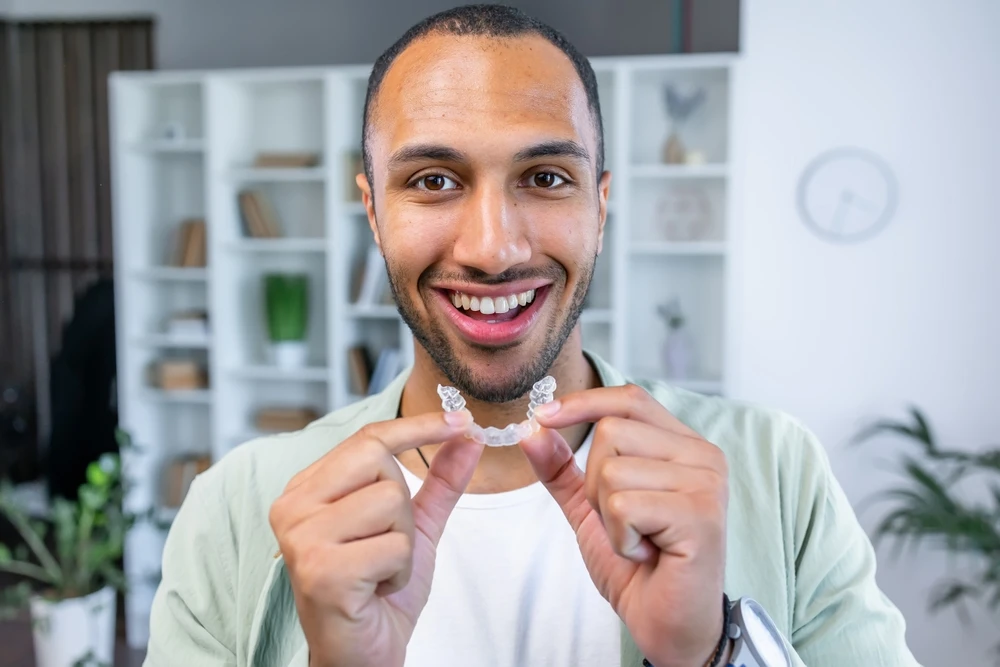
Does Invisalign Affect Your Face Shape Differently for Overbites vs. Underbites?
Yes, Invisalign affects your face shape differently depending on whether you have an overbite or an underbite, because each bite problem changes the face in a distinct way.
With an overbite, the upper front teeth extend too far forward over the lower teeth. This makes the chin look smaller or recessed and can give the lower face a sunken appearance. The upper lip may protrude while the lower lip looks thin or unsupported. When Invisalign corrects the overbite, the lower jaw can shift into a more forward position. The chin looks more defined, and the lip balance improves. Many patients with deep overbites report that their profile looks completely different after treatment.
With an underbite, the lower teeth extend beyond the upper teeth. This pushes the lower jaw forward and makes the chin appear too prominent. After Invisalign brings the bite into alignment, the lower jaw looks less protruding, and the face appears more harmonious. The correction softens what may have been an overly strong jaw appearance.
Can Invisalign Fix a Crossbite and Improve Facial Symmetry?
Yes, Invisalign can fix a crossbite and improve facial symmetry. A crossbite occurs when some upper teeth sit inside the lower teeth instead of outside them. This creates uneven bite pressure on one side of the face and can cause that side of the jaw to develop differently over time. The result is a face that looks lopsided or uneven.
Data from the European Journal of Paediatric Dentistry found that malocclusion, the category that includes crossbites, overbites, and underbites, affects 56% of the global population. In the United States, research published in PubMed estimates that between 57% and 59% of adults across all racial and ethnic groups have at least some degree of orthodontic treatment need. Crossbites are a significant contributor to these numbers.
When Invisalign corrects a crossbite, it removes the uneven forces that were pulling the jaw to one side. The result is a more symmetrical bite and, over time, a more even-looking lower face. A regular dental exam can help identify whether a crossbite is contributing to asymmetry you may not have fully noticed.
How Does Invisalign Affect Lip Support and Fullness?
Invisalign affects lip support and fullness by changing the angle and position of the teeth directly behind the lips. Your lips rest against your front teeth. When those teeth are tipped inward, crowded, or when a bite problem is pulling the jaw back, the lips lose the structural support they need to sit naturally. They can look thin, pulled in, or uneven.
As Invisalign moves the teeth into better positions, the lips regain that support. They begin to rest more naturally. Many patients notice that their lips look fuller after treatment, not because anything was added, but because the teeth underneath are now providing proper support. This effect is especially noticeable in patients correcting overbites, where the lower lip was previously unsupported and compressed by protruding upper teeth.
This is one of the changes that surprises people most. They came in to straighten their teeth and they walk away with lips that look completely different, in a good way.
Will My Cheeks Look Different After Invisalign?
Your cheeks may look different after Invisalign, especially if treatment includes any arch widening. A narrow dental arch can make the cheeks look hollow or sunken because there is not enough tooth structure underneath to provide support. When Invisalign expands the arch, the cheeks sit higher and look more defined. The overall mid-face appearance can look fuller and more youthful.
For patients without significant arch narrowing, cheek changes are more subtle. They may notice that their cheeks look slightly more even from side to side as bite asymmetry improves. This is not a dramatic change but it is often one that friends and family notice even when they cannot identify exactly what looks different.
Bite ProblemFacial Impact Before TreatmentFacial Change After InvisalignOverbiteRecessed chin, protruding upper lip, weak lower faceMore forward chin, improved lip balance, defined lower jawUnderbiteProminent lower jaw, overly strong chin appearanceSofter jawline, more proportionate chin and mid-faceCrossbiteFacial asymmetry, uneven jaw developmentMore symmetrical lower face, balanced jaw resting positionCrowding / Narrow ArchSunken cheeks, unsupported lips, compressed smileFuller cheeks, improved lip support, wider smile arcOpen BiteLips cannot close easily at rest, longer lower face appearanceLips close naturally, lower face looks more proportionate
Sources: National Institutes of Health (PMC), American Journal of Orthodontics, PubMed research on malocclusion and soft tissue facial changes.
How Long Does It Take to See Facial Changes from Invisalign?
Facial changes from Invisalign are typically visible within 3 to 6 months of starting treatment. The most significant and noticeable differences usually appear by the end of the full treatment period, which averages around 18 months according to data published in PMC from an analysis of the Align Global Gallery. That study found the average treatment duration was 18 months, with the upper arch requiring approximately 50 aligners and the lower arch about 48 aligners.
The earliest changes people notice tend to be in the lips and bite feel. The jawline becomes more defined as treatment progresses. By the time treatment is complete, the cumulative effect of all those small tooth movements adds up to a face that looks more balanced and more symmetrical than when treatment began.
It is important to be patient. These are not overnight changes. They are the result of steady, guided tooth movement and bone remodeling happening below the surface every single day you wear your aligners.
What Happens If I Stop Invisalign for 2 Weeks?
If you stop wearing Invisalign for 2 weeks, your teeth may begin to shift back toward their previous positions. Teeth are under constant pressure from the tongue, cheeks, lips, and gum tissue. Without your aligners providing counter-pressure, they will start to drift. Two weeks is enough time for noticeable movement in some patients, particularly in the front teeth where movement is fastest.
If this happens, do not panic. Put your current aligners back in right away and wear them for at least 48 hours before moving on. If they no longer fit properly, contact your dentist. You may need to go back one or two sets to regain your progress. Stopping treatment for extended periods can add time to your overall treatment plan and may undo facial improvements that were already underway.
Does Invisalign Affect Your Face Shape Differently for Adults vs. Teens?
Yes, Invisalign affects face shape differently for adults compared to teens because the bones respond differently based on how developed they are. For teenagers, the jaw and facial bones are still growing and are more responsive to the forces applied by the aligners. This means teens can often see more significant facial changes, including greater jawline definition and more noticeable improvements in facial symmetry.
For adults, the bones are fully developed, so the structural changes are more limited to the dental arch and bite function rather than broader skeletal changes. However, the soft tissue changes, including improvements in lip support, cheek fullness, and facial symmetry, are still very real for adult patients. A 2024 market report from Fortune Business Insights noted that adults now make up the largest segment of Invisalign users, with over 935,800 teens also starting treatment in 2025, reflecting strong adoption across all age groups.
Adults in the Hialeah area who are considering treatment often wonder if it is too late to see meaningful results. The honest answer is that while the changes may be subtler than in a teenager, they are still worth it. Many adult patients are surprised by how different their profile looks after correcting a bite problem they had lived with for decades. Adult orthodontics is more accessible and more effective today than it has ever been.
Can Adults Get Braces or Aligners Later in Life?
Yes, adults can get aligners later in life and see meaningful results. There is no upper age limit for Invisalign as long as your teeth and gum tissue are healthy enough to support orthodontic movement. In fact, adult orthodontics has become one of the fastest-growing areas in dentistry. Adults make up over 75% of the orthodontic market according to data from orthodontic treatment research published in 2025.
Gum disease and bone loss are the main things that can complicate adult orthodontic treatment. If these are controlled and managed, Invisalign is a viable and often excellent option for adults at any age.
Is Invisalign Better Than Braces for Facial Changes?
Invisalign is not necessarily better than braces for facial changes, but it produces facial changes through a gentler and more gradual process. Traditional metal braces apply constant, fixed pressure through brackets and wires, which can produce faster and sometimes more pronounced structural changes, especially in younger patients. Invisalign uses removable aligners that apply precise but softer forces, which typically results in more subtle facial refinements.
For mild to moderate bite problems, both options produce similar long-term facial outcomes. For severe skeletal misalignment, braces may be more effective, and in some extreme cases, surgery may be the only solution. A review article published in 2023 found that clear aligner therapy has a success rate of 80% to 90% for mild to moderate tooth movements when patients wear their aligners consistently.
The right choice depends on your specific bite, your bone structure, and what you are trying to correct. We work through all of these factors with each patient before recommending a path forward. If you are curious about how your situation compares, a detailed look at braces vs. clear aligners can give you a clearer picture of what each option delivers.
Can You Tell If Someone Is Wearing Invisalign?
Most people cannot tell if someone is wearing Invisalign during normal conversation. The aligners are made from clear, smooth plastic designed to fit snugly over the teeth. They are nearly invisible at normal speaking and social distances. This is one of the primary reasons adults prefer Invisalign over traditional metal braces. A survey cited by industry analysts found that 84% of teen patients preferred Invisalign over braces specifically because of how discreet it looks.
The most common giveaway is a slight lisp or speech change when patients first start wearing new aligners. This typically resolves within a few days as the mouth adjusts to the new fit.
Do You Have to Wear a Retainer Forever After Invisalign?
Yes, you do need to wear a retainer long-term after Invisalign, though "forever" does not mean all day every day. Most patients transition to nighttime-only retainer wear after the initial stabilization period, which typically lasts 6 to 12 months. After that, wearing a retainer a few nights a week is often enough to keep your teeth from drifting.
The reason retainers are necessary is that the soft tissue, ligaments, and bone around your teeth continue to exert natural pressure on them even after alignment is achieved. The body does not stop pushing. Teeth have a natural memory and will drift back toward their original positions without a retainer to hold them in place.
This matters for facial structure too. If your teeth drift back, the improvements in lip support, jaw balance, and facial symmetry that came with your treatment will also start to reverse. Protecting your results means protecting both your smile and the facial refinements that came with it. Orthodontic care does not end on the day you finish your last aligner set.
Will My Teeth Move If I Don't Wear My Retainer for 4 Days?
Your teeth can begin to move if you do not wear your retainer for 4 days, especially in the first year after completing treatment. The amount of movement varies by person. Some patients notice their retainer feels slightly tight after just a couple of days off. Others may not notice much change in a few days but will see gradual drift over weeks or months of inconsistent use.
The general rule is this: if your retainer still fits after a missed period, wear it immediately and continue your normal schedule. If it no longer fits properly, do not force it. Contact your dentist to assess whether new retainers are needed before any further drift occurs.
What Is the Biggest Complaint About Invisalign?
The biggest complaint about Invisalign is the discipline required to wear aligners for the recommended 20 to 22 hours per day. Unlike braces, which are fixed and cannot be removed, Invisalign success depends entirely on patient compliance. If aligners are regularly left out for more than 2 to 4 hours a day, tooth movement slows down or stops, and treatment takes longer than planned.
Other common complaints include initial discomfort when switching to a new aligner set, mild speech changes in the first few days of a new set, and the inconvenience of removing aligners before eating and drinking anything other than water. Most patients find these manageable once they build a routine around them.
Studies indicate that about 17% of patients who initially choose clear aligners switch to braces to address more severe misalignments that aligners alone cannot fully correct. This is why a thorough initial evaluation matters. We need to make sure Invisalign is the right fit for your specific situation before you invest time and money in treatment.
Frequently Asked Questions
Does Invisalign Affect Your Face Shape Even with Mild Misalignment?
Invisalign can affect your face shape even with mild misalignment, though the changes will be more subtle than in cases with severe bite problems. Even small shifts in tooth position can change how the lips rest, how the jaw closes, and how the profile looks at rest. Patients with mild crowding often notice a more open, symmetrical smile and improved lip symmetry after treatment.
Why Don't Dentists Recommend Invisalign for Every Patient?
Dentists do not recommend Invisalign for every patient because some cases are too complex for clear aligners alone. Severe skeletal discrepancies, significant bone loss, active gum disease, or very large bite corrections may require traditional braces or surgical intervention. Invisalign works best for mild to moderate alignment issues, and placing a patient in a treatment that does not match their needs would produce poor results. A proper exam and X-rays are the only way to determine if clear aligners are the right fit.
What Is the Hardest Week of Invisalign?
The hardest week of Invisalign is typically the first week of treatment. During this time, patients are still adjusting to wearing a foreign object in their mouth for 22 hours a day, speaking with the aligners in, and removing them before every meal. Discomfort from the first aligner set is also at its peak during this week, as the teeth begin to move for the first time. Most patients report that it gets significantly easier after the first 7 to 10 days.
What Percentage of People Quit Invisalign?
The exact percentage of people who quit Invisalign is not widely published in clinical data, but research suggests that compliance is the biggest predictor of treatment dropout. Studies indicate that about 17% of patients who start with clear aligners eventually transition to traditional braces, often because their case was more complex than aligners could handle efficiently. True mid-treatment abandonment is less common but does happen in cases where patients underestimate the daily discipline required to wear aligners consistently.
What If I Only Wear My Invisalign 15 Hours a Day?
If you only wear your Invisalign 15 hours a day instead of the recommended 20 to 22 hours, your treatment will slow down significantly and may not produce the expected results. Aligners need sustained pressure over time to move teeth. Wearing them for only 15 hours a day gives your teeth too much time to shift back between aligner sessions. Over weeks and months, this can throw off your entire treatment timeline and may require additional aligner sets to correct, adding both time and expense to your plan.
Can Invisalign Impact Jaw Pain or TMJ Symptoms?
Yes, Invisalign can impact jaw pain and TMJ symptoms, often in a positive way. When a misaligned bite is putting uneven stress on the jaw joint, correcting that alignment with Invisalign can reduce the strain. Many patients report less jaw clicking, less muscle tension, and fewer headaches after their bite is corrected. However, if TMJ symptoms are severe or structural, additional treatment may be needed alongside orthodontic care.
The Bottom Line
Invisalign does more than straighten teeth. By correcting bite problems, repositioning the jaw, and supporting proper alignment throughout the lower face, it creates real and lasting changes in how your face looks and feels. The improvements are not dramatic in most cases, but they are consistent, and they build over the full course of treatment.
For patients who want to go further after orthodontic treatment, smile design options can build on the structural improvements Invisalign creates, adding cosmetic refinements on top of a properly aligned foundation.
The key is choosing the right treatment plan for your specific bite, committing to full-time aligner wear, and protecting your results with a retainer afterward. Every step in the process matters, from the first scan to the last retainer check.
At Castellanos Dental, we take a thorough approach to every smile transformation. If you have questions about whether Invisalign is right for your bite or your facial goals, we would be glad to walk you through your options at a consultation.
.png)
.png)

.png)


.png)


.png)
.png)
.png)
.png)

.png)
.png)
.svg)


