.png)
.svg)
.png)

Best Invisalign Cleaning Routines After Eating
.png)
.png)
The best Invisalign cleaning routine after eating is to remove your aligners before every meal, rinse your mouth with water, brush and floss your teeth, gently clean your aligners with a soft-bristled toothbrush and mild clear soap, then wait about 30 minutes before putting them back in. This simple process protects your enamel, keeps your trays crystal clear, and keeps your treatment moving on schedule. In this guide, we walk you through every step of this routine, explain the science behind it, and answer the most common questions Invisalign wearers ask.
Why Cleaning Your Invisalign After Eating Really Matters
Invisalign aligners sit tightly over your teeth for up to 22 hours every day. That creates a warm, sealed environment where bacteria can multiply fast. According to a study published in the National Library of Medicine (PMC), clear aligners form a fully enclosed environment on tooth crowns, and when patients skip regular cleaning, that inner surface can have a negative impact on enamel health. Translation: dirty trays are not just a cosmetic problem; they can lead to real damage.
Research published in the Centers for Disease Control and Prevention (CDC) data shows that nearly 26% of adults in the United States already have untreated cavities. Wearing aligners without cleaning properly after meals makes that risk even higher because food sugars and acids get trapped directly against your enamel with nowhere to go.
The good news is that the fix is simple. A consistent post-meal routine takes about three to five minutes. It protects your teeth, keeps your trays invisible, and helps your treatment finish on time. We see this every day with our patients, and the ones who build this habit early have a much smoother Invisalign experience. Combining good aligner hygiene with regular professional teeth cleaning appointments gives your smile the best foundation possible during treatment.
What Happens If You Skip Cleaning After Meals
Skipping the post-meal routine is the number one mistake Invisalign wearers make. When food particles and sugars sit against your teeth inside the aligners, bacteria feed on them and produce acids. Those acids erode enamel. The aligners also start to look cloudy or yellow, which defeats the whole purpose of choosing a clear orthodontic treatment. You can also end up with bad breath that no amount of mouthwash can cover up because the odor source is inside the tray itself.
A study published in PMC's review of orthodontic treatment and oral health found that caries-associated bacteria actually increase in the environment created by clear aligners over time. That does not mean aligners cause cavities. It means that without good hygiene habits, the risk goes up significantly.
How Should I Clean My Teeth After Eating with Invisalign?
You should clean your teeth after eating with Invisalign by following a five-step process every time you remove your trays for a meal or snack. Here is exactly what to do:
Step 1: Remove your aligners before you eat or drink anything except water. This is non-negotiable. Never eat with your aligners in. Food can crack or warp them, and it pushes bacteria directly against your enamel.
Step 2: Rinse your mouth with water immediately after eating. This knocks loose food particles off your teeth and starts removing acids and sugars before you brush.
Step 3: Brush and floss your teeth thoroughly. Use a soft-bristled brush and fluoride toothpaste. Floss between every tooth to remove anything that brushing misses. Bacteria love hiding in those tight spaces, and your aligners will trap whatever you leave behind.
Step 4: Clean your aligners before putting them back in. Rinse them under lukewarm water first. Then gently scrub both the inside and outside with a separate soft-bristled toothbrush and a small amount of clear, unscented, mild liquid soap. Rinse thoroughly so no soap taste remains.
Step 5: Wait 30 minutes after eating before reinserting. This gives your saliva time to neutralize the acids that formed during your meal. Reinserting too soon traps those acids against your enamel. This is known as the 30-minute rule, and the American Dental Association supports waiting after eating to protect enamel and improve oral health outcomes.
You do not need any fancy products for this routine. Clear mild soap and a spare soft toothbrush are all it takes. That said, clear aligners also work well with official Invisalign Cleaning Crystals, which dissolve in cool water and disinfect the trays during a 15-minute soak.
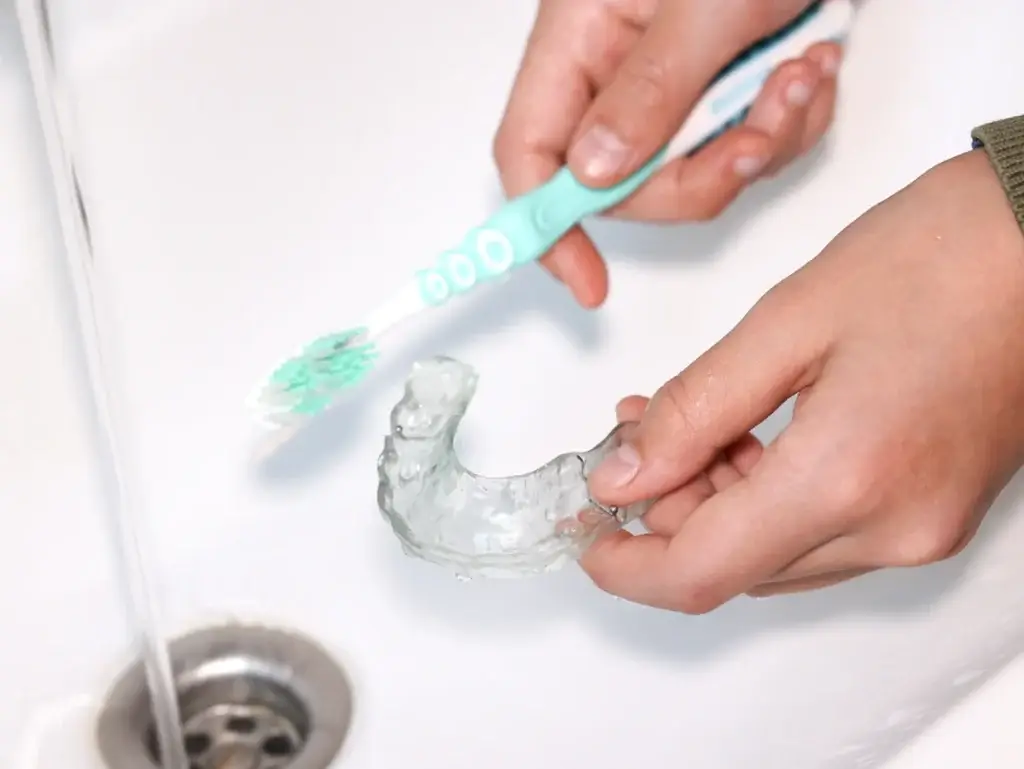
What Is the 30-Minute Rule for Invisalign?
The 30-minute rule for Invisalign is the practice of waiting at least 30 minutes after eating or drinking anything other than water before putting your aligners back in. After you eat, your mouth becomes more acidic as bacteria break down food particles and produce acid. A study published in the Journal of Dental Research found that acidic oral environments can cause measurable enamel erosion within just 15 to 30 minutes of exposure.
Here is the problem with reinserting too soon: the aligners cover your teeth and block your saliva from doing its job. Saliva naturally rinses away acids and restores the mouth's pH balance, but it can only do that when it can flow freely over your teeth. Your aligners get in the way of that process. By waiting 30 minutes, you give your saliva time to neutralize the acids naturally before you create a sealed environment again.
A common misunderstanding is that brushing right after eating is always the safest move. However, brushing too soon after a meal can actually wear down softened enamel. Rinsing with water first and then waiting a few minutes before brushing is the smarter approach. After brushing, waiting the remainder of the 30 minutes gives your enamel time to re-harden before you put the trays back on.
Does the 30-Minute Rule Apply to Drinks Too?
Yes, the 30-minute rule applies to drinks too, with the exception of plain water. Any beverage other than water introduces sugars, acids, or pigments into your mouth. Soft drinks, juice, sports drinks, and coffee all trigger an acid response in your mouth that takes time to neutralize. If you have a cup of orange juice in the morning, the same 30-minute waiting principle applies before your aligners go back in.
Why Can't I Drink Tea or Coffee with Invisalign?
You cannot drink tea or coffee with Invisalign aligners in because these beverages cause two serious problems: staining and warping. Coffee and tea contain natural pigments called tannins and chromogens that bond to the clear plastic material of your trays. Even one cup can cause visible discoloration, turning your aligners from transparent to a faint yellow or brown. That defeats the entire purpose of choosing invisible braces.
Heat makes the problem worse. The SmartTrack thermoplastic material that Invisalign uses can begin to deform at temperatures around 60 degrees Celsius (about 140 degrees Fahrenheit), which is cooler than most freshly poured coffee and tea. Even slight warping changes the fit of your trays, which means they stop applying the right pressure to move your teeth correctly.
When you drink coffee or tea with aligners in, liquid also gets trapped between the plastic and your tooth enamel. Coffee has a pH between 4.85 and 5.10, which means prolonged contact with your enamel in that sealed environment causes real erosion. The safest approach is to remove your aligners, enjoy your drink, then rinse, brush, and wait the 30 minutes before reinserting. You do not have to give up your morning coffee; you just need to follow the process.
The same logic applies to red wine, sports drinks, soda, and energy drinks. Plain water is the only beverage safe to sip while your aligners are in.
Is 20 Hours a Day OK for Invisalign?
Twenty hours a day is the minimum acceptable wear time for Invisalign, but 22 hours per day is the standard recommendation from most orthodontists, including the guidance from Align Technology. The difference matters. Invisalign works by applying constant, gentle pressure to guide teeth through a precise sequence of movements. Each tray is engineered to make small adjustments that only happen when the tray is in place and applying that pressure.
When aligners come out for meals and oral hygiene, you have roughly two to four hours each day for eating, drinking, and cleaning. That time adds up fast. Every extra snack or extended mealtime eats into your wear time. If you consistently fall below 20 hours, you risk stalled progress or trays that no longer fit properly when you try to move to the next set. This can mean additional refinement aligners and a longer treatment timeline.
Over 22 million people have used Invisalign as of 2025. Among them, research shows that 72% of patients already require additional refinement aligners after their initial series. Cutting into your daily wear time is one of the easiest ways to add to that number. Clear aligners have become popular among adults specifically because they fit into a real lifestyle, and adult orthodontics with aligners is now one of the most common treatment paths we see.
This is why the post-meal routine matters for treatment success, not just hygiene. The faster and more consistently you complete your cleaning routine and get your aligners back in, the more you protect your wear time and keep your treatment on schedule. If you are wondering whether your current progress is on track, a dental exam gives your provider a clear picture of how your teeth are moving.
Cleaning Products: What Works and What Damages Your Aligners
Not all cleaning methods are safe for Invisalign trays. Using the wrong product is a common mistake that leads to scratched, cloudy, or damaged aligners. Here is a clear breakdown of what works and what to avoid.
Safe Cleaning Options for Invisalign Trays
Clear, unscented, mild antibacterial liquid soap is one of the safest and most effective options. It kills bacteria, rinses away completely, and does not stain or scratch your trays. Use a soft-bristled toothbrush dedicated only to your aligners. Never use the same brush you use for your teeth; this transfers toothpaste residue onto the trays.
Invisalign Cleaning Crystals are the official product from Align Technology. You dissolve a packet in cool water and soak your trays for 15 minutes. This method is thorough and convenient, especially for a daily deep clean.
A white vinegar solution works well for a natural alternative. Mix equal parts white vinegar and cool water, soak for 15 to 20 minutes, then rinse thoroughly. Do not use colored vinegar, as it can stain the plastic.
A diluted hydrogen peroxide solution is another option. Combine one part 3% hydrogen peroxide with two parts water. Soak for 15 to 20 minutes, then rinse well before reinserting. This is a good choice for a weekly deep-clean soak.
Products That Damage Invisalign Aligners
Toothpaste is too abrasive for clear aligners. Most toothpastes contain silica, baking soda, or other abrasive agents that work well on enamel but scratch the soft plastic of your trays. Those tiny scratches create grooves where bacteria hide and make the trays look permanently cloudy.
Scented or colored soaps leave residue and can stain the plastic. Bleach and harsh chemical cleaners weaken the aligner material and leave harmful residue against your teeth. Hot water, even in the sink, can warp the trays permanently if they are soaked or rinsed in high temperatures. Always use cool or lukewarm water.
Alcohol-based mouthwash may seem like a convenient rinse for your trays, but the alcohol can dry out and crack the plastic over time. If you want to use mouthwash to clean your trays, choose an alcohol-free formula.
Comparison: Aligner Cleaning Methods at a Glance
Cleaning MethodEffectivenessSafe for Aligners?Best UseClear mild liquid soap + soft brushHighYesEvery meal / daily routineInvisalign Cleaning CrystalsVery HighYes (official product)Daily 15-minute soakWhite vinegar + water solutionModerate-HighYes (clear vinegar only)Alternative daily soakHydrogen peroxide + water (1:2 ratio)HighYes (3% concentration only)Weekly deep cleanToothpasteLowNo (too abrasive)Never use on alignersHot water rinseLowNo (warps plastic)Never use on alignersBleach or harsh chemicalsN/ANo (weakens material)Never use on alignersAlcohol-based mouthwashLowNo (dries/cracks trays)Never use on aligners
Sources: Healthline; Freeman Orthodontics; Mansfield Orthodontics; Invisalign official care guidance
How to Build a Daily and Weekly Cleaning Schedule
A consistent schedule is the difference between aligners that stay clear and trays that turn yellow and smell bad within days. Think of it in three layers: after every meal, every night before bed, and once a week for a deep clean.
After Every Meal or Snack
Every time you eat or drink anything other than water, follow the five-step routine. Remove aligners, rinse your mouth, brush and floss, clean your trays with soap and a soft brush, and wait 30 minutes before reinserting. This applies to snacks too, not just full meals. Frequent snacking without proper cleaning is one of the fastest ways to let bacteria build up inside your trays.
If you are on the go and cannot brush immediately, rinse your mouth thoroughly with water and rinse your aligners before putting them back in. A quick rinse is always better than nothing. Carry a small travel toothbrush, floss picks, and your aligner case in your bag or car so you are never caught without what you need. This is especially important in the Hialeah area, where people are often out and about during the day.
Every Night Before Bed
Your nighttime cleaning is the most important session of the day. Before you go to sleep, brush and floss your teeth thoroughly, then give your aligners a proper cleaning. Rinse them under lukewarm water, scrub gently with clear soap and your aligner brush, rinse again, and insert them for the night. Nightly cleaning removes the day's full accumulation of bacteria, plaque, and food residue. Patients who want extra cavity protection during treatment sometimes ask about dental sealants as an added layer of defense on back molars where food tends to hide.
This is also a good time for a soak if you are using Invisalign Cleaning Crystals or a diluted hydrogen peroxide solution. A 15-minute soak during your evening shower or while you watch TV is easy to fit in without any extra effort.
Once a Week: Deep Clean
Once a week, do a deeper cleaning session to remove any buildup that daily brushing misses. Soak your trays in a 1:2 hydrogen peroxide and water mixture for 30 minutes. Follow with gentle scrubbing, then rinse for a full 60 seconds. You can also make a paste from two parts baking soda and one part water for a gentle scrub, but use this sparingly as baking soda can be mildly abrasive over repeated use. This weekly reset keeps your trays smelling fresh and looking transparent all the way through to the next tray change.
While you are doing your weekly routine, take a moment to inspect your trays. If they look cloudy or have visible residue that brushing and soaking will not budge, that is a sign your daily routine needs some adjusting. You should also clean the inside of your aligner case at least once a week. Bacteria grow inside the case too, and a dirty case recontaminates clean trays every time you store them.
What Can You Not Eat with Invisalign?
You cannot eat anything while your Invisalign aligners are in your mouth. The instruction is not about specific foods; it is about removing your trays for all eating. Food can crack or chip the aligner material, and chewing forces the trays into positions they were never designed to handle. Even soft foods can push the trays off alignment if you are biting down with them in.
That said, some foods and drinks require more caution during your cleaning routine. Highly acidic foods like citrus, tomatoes, and vinegar-based dressings raise mouth acidity more than neutral foods, so you want to be especially thorough when rinsing and brushing after those meals. Sticky or sugary foods leave more residue behind and need extra attention during flossing. Dark-pigmented sauces, curry, and berries can stain your teeth if left behind when trays go back in, which in turn stains the inside of the trays over time. Your provider may also recommend fluoride treatments to help strengthen enamel that faces additional acid exposure during aligner wear.
Chewing gum should never be done with aligners in because it sticks to the trays. Smoking with aligners in is also a serious mistake. Tobacco smoke turns clear trays a dark yellow-brown almost immediately and creates a buildup inside the trays that no amount of cleaning fully removes.
What Happens If I Don't Wear My Invisalign for 22 Hours a Day?
If you do not wear your Invisalign for 22 hours a day, your teeth begin to drift back toward their original positions during the hours your trays are out. Teeth are not fixed in bone; they sit in a flexible ligament that responds to pressure. Without consistent aligner pressure, that ligament allows teeth to shift. According to Align Technology's Invisalign protocol, the treatment relies on sustained, incremental force to move teeth through each planned stage. Even a few extra hours out per day can cause your current tray to feel too tight or your next tray to not fit at all.
When trays stop fitting properly, your options are an additional set of refinement aligners or a longer treatment timeline. Given that 72% of Invisalign patients already need refinements, reducing your daily wear time is one of the biggest avoidable risks in treatment.
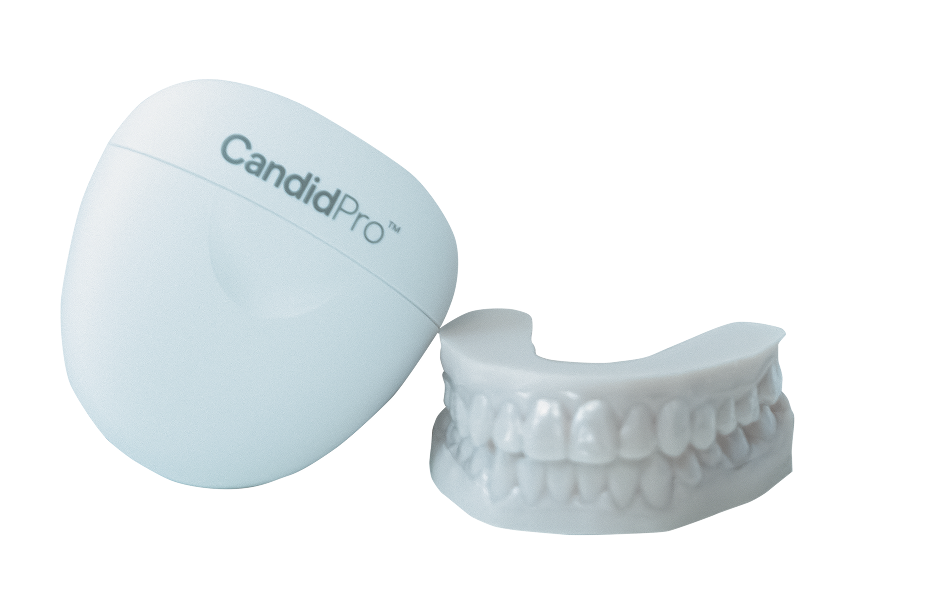
The 30-minute post-meal routine helps you manage this directly. If you have three main meals per day and spend 30 minutes on each, that is only 1.5 hours of aligner-free time for eating. Add 30 minutes of total cleaning and prep time, and you are still well within the 2 to 4 hours you have available each day. The key is not to let meals extend or to let aligners stay out after the 30-minute window has passed. Our Candid invisible aligner patients follow the same wear-time guidelines and consistently see better outcomes when they treat the cleaning routine as a fixed part of their day.
How to Have a Night Out with Invisalign
You can have a night out with Invisalign by planning your aligner removal time carefully and keeping a small travel hygiene kit with you. Here is how to handle a dinner out, a party, or any social event without sacrificing your wear time or your oral hygiene.
Before you leave home, brush and floss your teeth and make sure your trays are clean. Put your aligner case in your bag so you always have a clean, safe place to store them. When you arrive at dinner, remove your aligners discreetly before the meal and store them in your case. Never wrap them in a napkin; this is how most aligners get accidentally thrown away or damaged.
After eating, if there is no good opportunity to brush, rinse your mouth thoroughly with water. Swish for a full 30 seconds to remove food particles and acids. When you get a moment to step away, brush if you can. Reinsert your trays within the 30-minute window after finishing your meal. If you are drinking at a social event, remove your aligners before any beverage other than water. This protects against staining and keeps acids from being trapped against your teeth.
For longer events where you might be eating and drinking over several hours, aim to wear your aligners for as many of those hours as possible by timing your eating to one or two concentrated windows rather than grazing all night. The clear aligner versus braces comparison is often settled right here: this kind of flexibility is exactly why so many people choose clear aligners.
Can People Tell You Are Wearing Invisalign?
People generally cannot tell you are wearing Invisalign as long as your aligners are kept clean and clear. The trays are made from a transparent thermoplastic material designed to sit flush against your teeth with no visible wires or brackets. In normal conversation or social settings, they are nearly undetectable.
The most common reason aligners become visible is discoloration from improper cleaning. Yellow or brown trays catch the light in a way that makes them obvious. This is entirely preventable with consistent post-meal cleaning. A research-backed stat from clear aligner market reports confirms that 84% of prospective teen patients choose Invisalign over traditional braces specifically because of aesthetics and confidence. Keeping your trays clean is how you protect that advantage every single day.
Dry mouth can also make aligners more noticeable because they do not fit as smoothly without adequate saliva. Staying well hydrated and drinking plenty of plain water throughout the day helps. Water also rinses your teeth naturally between meals, which reduces bacteria buildup inside your trays.
Frequently Asked Questions
How Often Should I Clean My Invisalign Trays?
You should clean your Invisalign trays every time you remove them, which means at least three times a day at each main meal plus a thorough nightly cleaning. The nightly clean is the most important because it removes a full day of accumulated bacteria before you sleep with the trays in for eight or more hours. A weekly deep soak addresses any buildup that daily brushing misses.
What Is the Biggest Complaint About Invisalign?
The biggest complaint about Invisalign is the discipline required to keep up with the daily wear time and cleaning routine, especially when eating out or traveling. Many patients also find the first few days after switching to a new tray uncomfortable as pressure builds on teeth. According to patient satisfaction data, Invisalign users rate their experience at about 8.7 out of 10, which means the vast majority of people find the routine manageable once they settle into it.
Why Do People Quit Invisalign?
People quit Invisalign most often because they underestimate the commitment required to wear the trays consistently and maintain a proper hygiene routine. Missing wear time, forgetting aligners at home, or growing frustrated with the post-meal cleaning routine are the most common reasons patients fall off track. Discomfort during tray changes and unexpected treatment extensions also contribute. These outcomes are largely preventable with a solid daily routine and regular check-ins with your provider.
Does Your Jawline Change After Invisalign?
Your jawline can change after Invisalign in some cases, depending on the nature of your original bite. Correcting an overbite, underbite, or crossbite changes how your upper and lower jaws align when you close your mouth. For patients with significant bite corrections, this can result in a more balanced facial profile. Purely cosmetic tooth movement, such as closing gaps or straightening crowded teeth, tends to have a minimal effect on the jawline itself.
Which Hurts Less, Braces or Invisalign?
Invisalign hurts less than traditional braces for most patients. Braces apply pressure through metal brackets and wires that can poke soft tissue and cause persistent soreness. Invisalign trays use smooth plastic that sits flush against the teeth and gums. Most Invisalign patients describe discomfort as mild pressure that lasts two to three days after switching to a new tray, then eases. Braces wearers often report more continuous irritation throughout treatment. That said, every patient's experience differs based on their bite complexity and sensitivity.
How Long Does Invisalign Take to Straighten Teeth?
Invisalign treatment takes anywhere from 6 to 22 months to straighten teeth, with the average treatment running 12 to 18 months for most adults. Simple cases with minor crowding or small gaps can finish in as little as six months. Complex bite corrections take longer. Consistent wear time, proper cleaning habits, and attending all follow-up appointments are the biggest factors that keep treatment on the shorter end of that range. You can read more in our full post on how long Invisalign takes to straighten teeth.
Can I Switch Invisalign Trays Every Week Instead of Every Two Weeks?
You can switch Invisalign trays every week if your specific treatment plan is designed for weekly changes, which is the case for many newer Invisalign protocols. Some older or more complex plans still use two-week intervals. Never switch to your next tray before your provider's specified timeline without consulting them first. Moving to the next tray too early means the current tray has not finished its planned movement, which can create gaps between your actual tooth position and what the next tray expects. Always follow your provider's schedule.
The Bottom Line
A great Invisalign cleaning routine after eating comes down to five habits: remove before every meal, rinse your mouth, brush and floss, clean your trays with mild soap and a soft brush, and wait 30 minutes before reinserting. Do this consistently, back it up with a nightly deep clean and a weekly soak, and your aligners stay clear, your teeth stay healthy, and your treatment moves forward without delays. The clear aligner market has grown to over $6 billion globally because millions of people have proven that this system works when you commit to it.
If you are ready to start your Invisalign journey or want to make sure your current treatment is on track, we would love to help. At Castellanos Dental, we guide our patients through every step of the process, from your first scan to your final tray.
.png)
.png)

.png)


.png)

.png)
.png)
.png)
.png)

.png)
.png)
.svg)


